The Office Is the New Forecourt: How Salary Sacrifice Became Britain's Fastest-Growing Route to a New Car
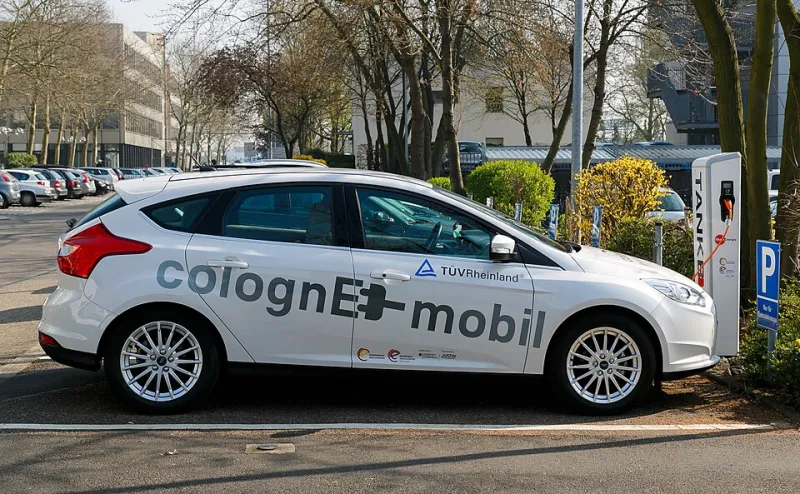
Photo: CEphoto, Uwe Aranas, CC BY-SA 3.0, via Wikimedia Commons
There was a time when arranging a new company car involved a fleet manager, a glossy brochure and very little choice. Today, the conversation is more likely to happen with your HR department, over a benefits portal, with the car of your choosing delivered to your driveway. Electric vehicle (EV) salary sacrifice schemes have turned the workplace into one of Britain's fastest-growing gateways to the forecourt — and the numbers explain why.
The Tax Mechanics, Without the Jargon
At its heart, salary sacrifice is refreshingly simple. You agree to give up a portion of your gross salary, and in exchange your employer leases an electric car on your behalf. Because the deduction comes out of your pay before Income Tax and National Insurance are calculated, you effectively fund the car from untaxed earnings.
The savings stack up in three places. First, you avoid paying tax on the sacrificed amount. Second, both you and your employer contribute less National Insurance. Third — and this is the part that makes EVs uniquely suited to the arrangement — fully electric cars attract Benefit in Kind (BiK) tax at just 2% of the vehicle's list price for the 2024/25 and 2025/26 tax years. Compare that with the 20% to 37% BiK rates applied to many petrol and diesel equivalents, and the arithmetic becomes compelling.
What a Typical Driver Actually Saves
Consider a 40% taxpayer leasing a mid-range electric hatchback with a list price of around £35,000. On a commercial lease, the monthly cost might sit near £500. Through salary sacrifice, after accounting for the 2% BiK charge and the income tax relief, the effective take-home reduction often lands between £250 and £320 per month.
For a basic-rate taxpayer, the saving is smaller in absolute terms but still material — typically £150 to £220 a month against an equivalent personal lease. Over a three-year term, that can amount to £7,000 or more in avoided cost. It is one of the few remaining tax-efficient perks available to ordinary employees, which is precisely why uptake has surged since 2020.
The Catch: What Happens If You Move On
No honest assessment of salary sacrifice is complete without the word 'risk'. The standard lease term runs 24 to 48 months, and if you leave your employer — whether by choice or circumstance — the agreement doesn't simply evaporate. Most schemes carry an 'early termination' clause requiring you to cover the outstanding lease costs, or a proportion of them.
Reputable providers now offer early termination protection, capping the employee's liability, often at a fixed number of monthly payments or by insuring the risk outright. Before signing, employees should ask three questions: Who bears the cost if I resign? What happens during statutory leave, such as maternity or long-term sick leave? And is there a probation period before I can join the scheme?
Why Employers Are Embracing It
From the employer's perspective, the appeal is straightforward. Salary sacrifice schemes cost the business little to run — the employee's sacrifice typically covers the lease — while delivering a tangible, valued benefit at zero net cost. Employers save on their own National Insurance contributions too, though some pass a portion of this back to the scheme provider.
There is also the sustainability agenda. For companies with net-zero commitments, enabling low-emission commuting among staff is one of the most visible levers available. A fleet of employee EVs does more for a corporate ESG report than a year of offset purchases.
Is It Right for You?
Salary sacrifice suits drivers who value predictability. Insurance, servicing, maintenance and breakdown cover are bundled in, removing the administrative friction of ownership. It works best for those with stable employment, a comfortable margin in their monthly budget, and access to home charging — reliance on public rapid chargers can erode the running-cost advantage considerably.
It suits less well those contemplating a career move, buyers of very low-value vehicles where the savings are marginal, and anyone whose take-home pay would fall below National Minimum Wage after the sacrifice — a legal floor providers must respect.
A Quiet Revolution
No showroom was built, no advertising campaign launched, yet thousands of UK employees now lease electric cars through their payslips each year. For drivers willing to read the small print, the workplace has become the most cost-effective door to the forecourt — and there is little sign of the trend slowing.